Book
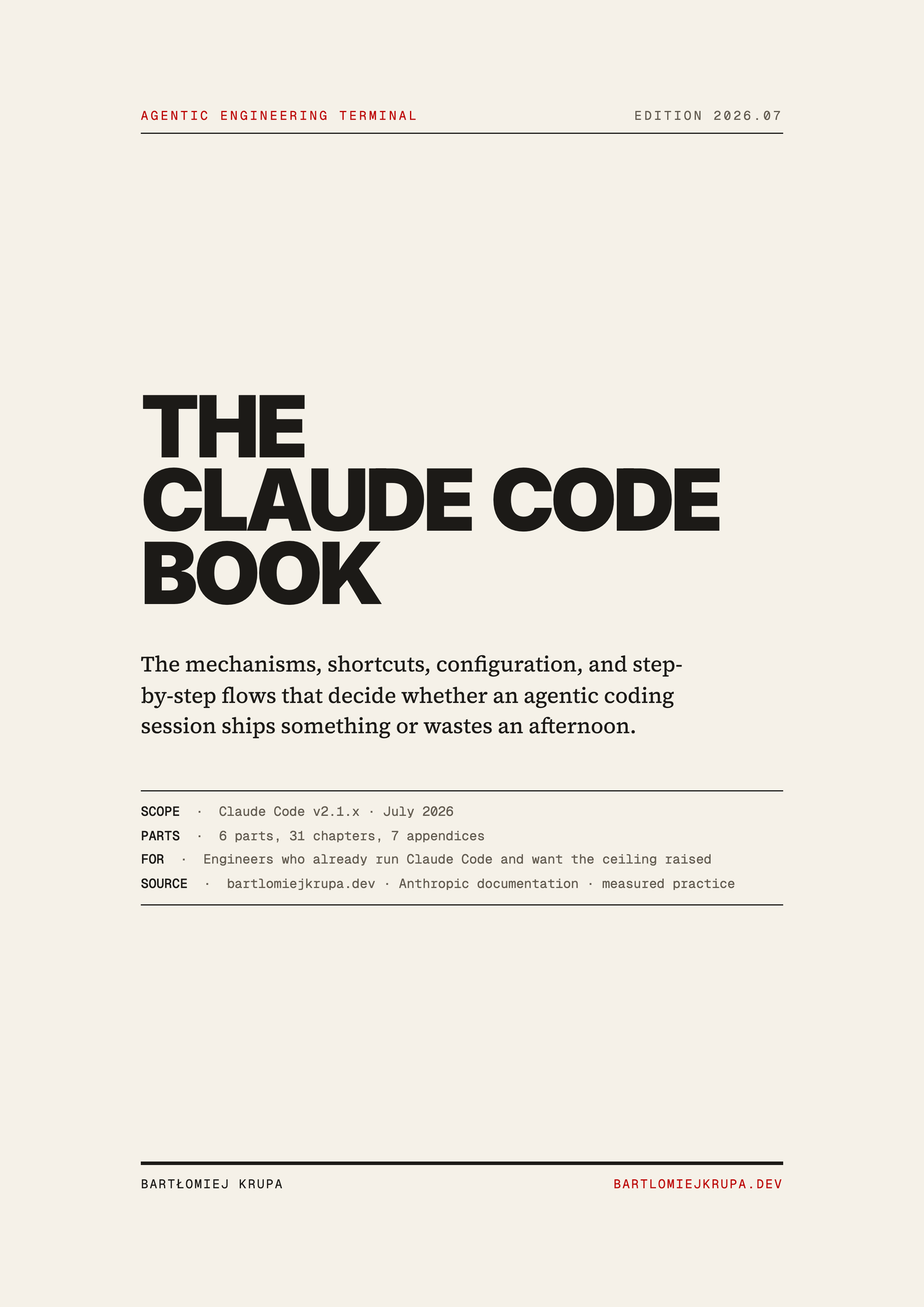
The Claude Code Book
The agent forgets half your CLAUDE.md, reads files you never named, and calls the job done when it is not. That usually is not the model. It is the runtime around it - tools, context window, permissions, when a turn ends. Nearly all of it is configurable. This is the manual for that layer.
- PRICE
- Free
- PAGES
- 156
- FORMAT
- PDF (A4)
- PARTS
- 6
- CHAPTERS
- 31
- APPENDICES
- 7
- PROMPTS
- 19
- EDITION
- 2026.08
- COVERS
- Claude Code v2.1.210-220
What_you_can_do_afterwards
- Explain where every token in your context window came from - and drop the ones you did not want.
- Write a CLAUDE.md the agent actually follows, and know what to move out of it.
- Pick the right extension point - skill, subagent, hook, MCP - instead of whichever one you learned first.
- Run an unattended multi-turn task that stops on a machine-checked condition, not a vibe.
- Recover a session that has gone wrong in under thirty seconds.
Contents
Six parts and seven appendices. I-III cover the machine and the files that change it; IV is procedures you run with the book open beside the terminal.
PART I
Mechanism
How the agentic loop and the context window actually behave: what loads at startup, why the middle of a long session gets lost, what compaction keeps and what it drops.
- 01The agentic loop
- 02The startup tax: what loads before you type
- 03The context window: replay, decay, compaction
- 04Tools and the permission split
- 05Permission modes and the sandbox ladder
PART II
Controls
Keyboard shortcuts, the five prefixes, the complete slash-command map, and the CLI flags that change what happens.
- 06Keyboard shortcuts
- 07The five prefixes
- 08Slash commands: the complete map
- 09The CLI: flags that change outcomes
PART III
Harness
The files that change behaviour: CLAUDE.md, project rules, skills, subagents, hooks, MCP, settings.json - and how to choose between them.
- 10CLAUDE.md: why agents ignore it
- 11Rules, imports, and auto memory
- 12Skills
- 13Subagents
- 14Hooks
- 15MCP
- 16Plugins
- 17settings.json
PART IV
Flows
Nine step-by-step procedures, start to finish, each written to be followed with the book open beside the terminal.
- 18Explore → Plan → Implement → Commit
- 19Spec-first: let Claude interview you
- 20Test-driven: the red-green loop
- 21The debugging escalation ladder
- 22The unattended run
- 23Parallel sessions: worktrees and writer/reviewer
- 24Fan-out: one migration, two thousand files
- 25Onboarding to an unfamiliar codebase
- 26Recovery: when it has gone wrong
PART V
Economics
Model tier, effort, thinking budgets, prompt caching, output budgets, and how to score the result with evals.
- 27Model tiers: pick by role, not benchmark
- 28Effort, thinking, and fast mode
- 29The cost levers that actually move the bill
- 30Evals: keeping the cuts honest
PART VI
Prompts
18 numbered prompts you paste from instead of retyping, plus the six patterns they are built on.
- 31The prompt library
APPENDICES
Reference
The parts you come back to: one page to print, two skeletons to copy, a table to scan when something is wrong, and where every fact came from.
- AThe one-page cheatsheet
- BThe lean CLAUDE.md skeleton
- CThe ten-file harness
- DSymptom → cause → fix
- EGlossary
- FSources
- GIndex
Sample_page
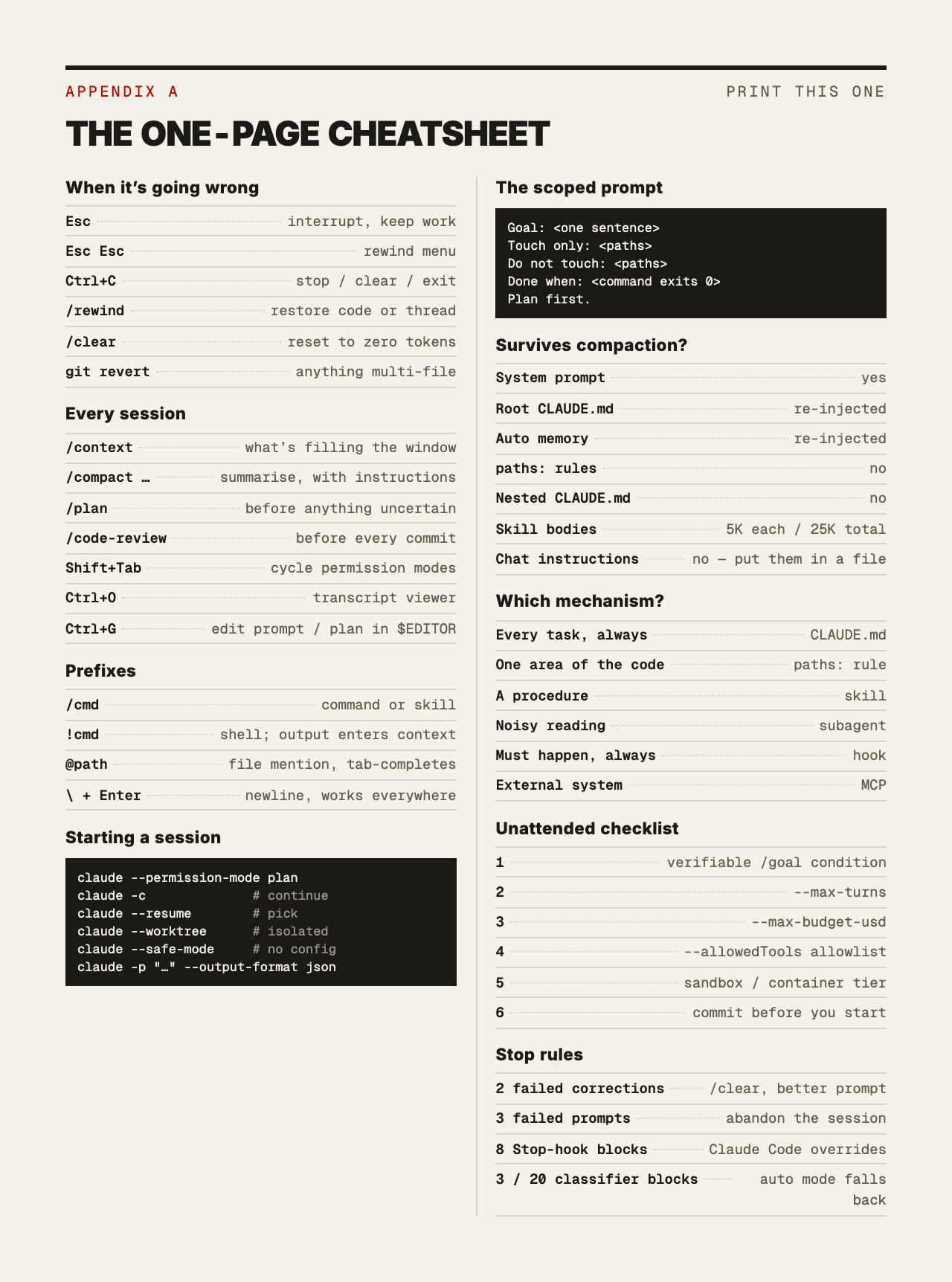
Appendix A at full size - the page most readers print and leave beside the keyboard. Fair sample of the typesetting.
Where_the_facts_come_from
Anthropic's docs cover the mechanics: tool behaviour, hook contracts, frontmatter, flags. Measured practice covers the thresholds - the ~84% drop in permission prompts from sandboxing, the 150-200 instruction adherence ceiling, the 85% cut in upfront tool tokens Anthropic measured for deferred tool loading on the API (the same pattern Claude Code applies to MCP). Appendix F cites each one and how far it travels. Ordering - which lever first - is mine, and where I am unsure I say so.
FAQ
- Who is The Claude Code Book for?
- Engineers who already run Claude Code and have hit the ceiling: forgotten instructions, ignored CLAUDE.md, unsolicited file reads, "done" that is not. You need a terminal and opinions about your own codebase - not an AI research degree.
- What version of Claude Code does it cover?
- Claude Code v2.1.210-219, written in July 2026. Every version-gated fact is tagged with the version that introduced it, so you can see whether a feature exists on your install.
- What does it cost?
- Nothing. Subscribe, confirm the address, and the full PDF opens on the next screen - not a sample chapter. The newsletter is harness engineering, LLM optimization, and cutting AI cost, sent when it earns a send. Unsubscribe anytime; the book stays yours.
- Claude Code ships several releases a week. Will the book go stale?
- Parts of it will. Anything about a weekly-shipping tool ages. Version-gated facts are tagged so you can tell whether a paragraph still matches your install. The underlying mechanisms - context windows, harness gates, cost reasoning - move much slower than the flags.
- What format do I get?
- One PDF: 156 A4 pages, print and screen, linked table of contents, page-numbered index. No ePub or Mobi.
- How is this different from the articles on this site?
- Most of the raw material is already here. Appendix F lists the twenty-seven articles behind the thirty-one chapters - read them all and you cover most of the same ground, in publish order, each tied to that week's Claude Code. The book adds what the pile cannot: one order, cross-references, facts re-checked against one version, nine step-by-step flows, and seven appendices (cheatsheet, CLAUDE.md skeleton, ten-file harness, symptom table, glossary, sources, index). Appendix C's ten-file harness is also free on npm as leanharness - the appendix is the reasoning, not the files.
- Is this an official Anthropic product?
- No. Independent and unaffiliated. Claude and Claude Code are Anthropic trademarks, used here to name the tool the book is about.
Where should it go?
Confirm the address. The book opens on the next screen. The newsletter follows when it earns a send; one click in any email ends it. The book stays yours either way.
No spam. No trackers. Unsubscribe anytime.
What_happens_next
Confirm the address
One-click confirmation email. Nothing goes out until you click - that click is consent, and it opens the book.
The email follows
The same link arrives by email so you can come back to it. A link, not an attachment - corporate filters have nothing to bounce.
Then the newsletter
Harness engineering, LLM optimization, cutting AI cost - sent when it earns a send, not on a schedule. One-click unsubscribe in every email.
Not an official Anthropic product - independent and unaffiliated. "Claude" and "Claude Code" are trademarks of Anthropic, used here to name the tool this book is about.